

Social Security Benefits

Electing Delayed Social Security Retirement Benefits

What is it?Electing Delayed Social Security Retirement Benefits

You can elect to delay receiving Social Security retirement benefits

You can choose to delay receiving Social Security retirement benefits until you are past normal (full) retirement age. Perhaps you want to work longer because you enjoy it, or maybe you want your retirement benefit to be higher when you finally do retire.

Your benefit will be increased by the delayed retirement credit

If you are eligible to receive Social Security retirement benefits but you delay receiving benefits until after normal retirement age, you will be eligible to receive the delayed retirement credit. The delayed retirement credit increases your retirement benefit by a predetermined percentage of your primary insurance amount (PIA) for each month you delay receiving retirement benefits up to the maximum age of 70. The amount of the credit you receive depends upon two factors:

  • What year you were born
  • How many months you delayed receiving retirement benefits past normal retirement age

If you were born in 1943 or later, you will receive 2/3 of 1 percent more per month or 8 percent more per year if you delay receiving retirement benefits. So, for example, if your normal retirement age is 66, and you delay retirement until age 70, your benefit at age 70 will be 32 percent more than it would be at age 66. If your normal retirement age is 67, and you delay retirement until age 70, your benefit at age 70 will be 24 percent more than it would be at age 66.

Although the delayed retirement credit increases your Social Security retirement benefit, it does not increase your PIA.

When can it be used?

You must be eligible to receive delayed retirement benefits

In order to receive delayed retirement benefits, you must meet the following criteria:

  • You must be at least one month older than normal retirement age, and
  • You must be fully insured for retirement benefits (in most cases have 40 quarters of coverage).
You must apply for benefits

Receiving delayed retirement benefits is not automatic. You must apply for benefits when you want to begin receiving them. The Social Security Administration (SSA) recommends that you contact an SSA representative two or three months before you want to begin receiving benefits. You can call the SSA at 1-800-772-1213 for more information.

Strengths

Your retirement benefit will increase

If you continue to work past normal retirement age and delay receiving Social Security retirement benefits, you may increase your retirement benefit in two ways. Not only will you receive a delayed retirement credit, but your earnings after normal retirement age may be substantial enough to increase your average indexed monthly earnings (AIME), upon which your benefit is based.

Your surviving spouse’s benefit will increase

If you elect to receive delayed retirement benefits, then die, your surviving spouse (at normal retirement age) may receive 100 percent of the benefit you were receiving. Therefore, if your spouse has a life expectancy substantially greater than your own, you might consider delaying retirement so that your spouse may receive a higher benefit after you die.

Your delayed retirement credit isn’t counted toward your family maximum

When you retire, your family may be eligible to receive benefits based on your PIA. These benefits may be limited by the family maximum, which generally ranges from 150 to 180 percent of your PIA. However, if you delay receiving retirement benefits, your delayed retirement credit won’t count toward your family maximum and can be paid whether or not your family’s benefits are limited by the family maximum.

Tradeoffs

Delaying retirement won’t necessarily increase your lifetime retirement benefit

Just because you receive a higher monthly benefit when you delay retirement doesn’t necessarily mean you’ll receive a higher overall lifetime benefit. If you delay receiving retirement benefits, the amount of each benefit check will be higher, but you’ll receive fewer benefit checks than you would have if you begin receiving retirement benefits at normal retirement age. How many fewer checks you receive will depend upon how many years you delay receiving retirement benefits.

For example, assume the following facts apply to you:

  1. You delay retirement by 4 years, and retire at age 70 instead of at age 66, making you eligible for an 8 percent delayed retirement credit for each year you delay retirement. You will receive 48 fewer benefit checks.
  2. Your PIA is $1,000, so if you retire at age 66, your annual benefit will be $12,000. If you retire at age 70, your monthly benefit will be increased by $320, so your annual benefit will be $15,840.
  3. Assume that even if you’ve saved or invested all or part of your benefits, your real rate of return is 0 percent.

Using these factors, it would take you more than 12 years from the time you retire at age 70 to reach the point at which your benefits would crossover with the amount you would have accumulated if you began receiving benefits at age 66 (does not take into account annual cost of living increases):

By this Age

Accumulated Benefit if Retirement Age is 66

Accumulated Benefit if Retirement Age is 70 (32% credit has been earned)

70

$ 48,000

$0

76

$120,000

$95,040

82

$192,000

$190,080

83

$204,000

$205,920

If you were to die before reaching this crossover point, your lifetime benefits would be lower than if you had retired at your normal retirement age. Conversely, if you were to die after reaching this crossover point, then your lifetime benefits would be higher. That’s why life expectancy is one of the factors to consider when deciding whether to delay receiving Social Security retirement benefits.

The delayed retirement credit won’t increase benefits paid to most family members

When you earn the delayed retirement credit, your retirement benefit will increase. However, because the delayed retirement credit doesn’t affect your PIA, benefits that are paid to family members won’t increase (unless you die, at which time your surviving spouse may receive the same benefit you were receiving).

How to do it

Decide whether you want to delay receiving retirement benefits by comparing your options

You can estimate your retirement benefit online using the Retirement Estimator calculator on the Social Security website (ssa.gov). You can create different scenarios based on current law that will illustrate how different earnings amounts and retirement ages will affect the benefit you receive. Remember, this considers only your earnings and gives a basic calculation of the amount you earn from delaying. If you have anything more complex, like retirement as a couple or pulling from an ex-spouse’s benefit,  you might want to work with an expert to ensure you have not missed any of the details that might affect your benefits; we can help with a flat fee Social Security plan that will give you peace of mind with the current 2800+ regulations that govern Social Security.

Consider the following questions before making your decision
  • Why do you want to delay receiving retirement benefits?
  • Can you afford to delay receiving retirement benefits, or do you need Social Security retirement income as soon as possible?
  • Do you expect to live long enough to benefit from delaying your retirement benefits?
  • How important is it to increase the amount of survivor income available to your spouse?
Apply for delayed Social Security retirement benefits

Three months before you’re ready to retire, fill out an application for benefits with the SSA.

Don’t forget to apply for Medicare benefits at age 65. See Questions & Answers.

Tax considerations

If you continue to work past normal retirement age, you will continue to pay Social Security or self-employment tax on your covered earnings. Even though your earnings may increase your AIME (and thus your retirement benefit), you may not be able to recoup those payroll taxes.

Questions & Answers

If you delay receiving Social Security retirement benefits, can you still receive Medicare at age 65?

Yes. Anyone age 65 or older who is entitled to receive Social Security benefits is eligible to receive Medicare, even if he or she has not yet filed an application for Social Security benefits. However, enrollment in Medicare is automatic only for individuals who are receiving Social Security retirement benefits for at least four months before reaching age 65. If you elect to delay receiving retirement benefits, you will need to apply for Medicare benefits online, in person, or through the mail.

Can you delay receiving Social Security retirement benefits until you’re 71 or older?

Yes, but there’s no advantage to waiting longer than age 70 to begin receiving Social Security retirement benefits. You can earn the delayed retirement credit only up until age 70. In addition, if you want to work, any money you earn from working after age 70 won’t decrease your Social Security retirement benefit. So why wait?

If you are interested in our Social Security planning options, learn more here! We understand retirement planning can be daunting, and we are here to make it easier for you. Our newsletter is a great way to stay up-to-date with our latest offerings and get helpful retirement planning tips. Signing up is easy; click here. We appreciate your interest in our services and look forward to helping you retire better!

Broadridge Investor Communication Solutions, Inc. prepared this material for use by Social Security Benefit Planners, LLC.

Broadridge Investor Communication Solutions, Inc. does not provide investment, tax, legal, or retirement advice or recommendations. The information presented here is not specific to any individual’s personal circumstances. To the extent that this material concerns tax matters, it is not intended or written to be used, and cannot be used, by a taxpayer for the purpose of avoiding penalties that may be imposed by law. Each taxpayer should seek independent advice from a tax professional based on individual circumstances. Social Security Benefit Planners, LLC  provide these materials for general information and educational purposes based upon publicly available information from sources believed to be reliable — we cannot assure the accuracy or completeness of these materials. The information in these materials may change at any time and without notice.

Social Security Benefit Planners, LLC and its affiliates are in no way associated with or approved, endorsed, or authorized by the Social Security Administration.


Social Security Retirement Benefit Basics

Social Security Retirement Benefit Basics

Social Security benefits are a major source of retirement income for most people. Your Social Security retirement benefit is based on the number of years you’ve beenSocial Security Retirement Benefit Basics working and the amount you’ve earned. When you begin taking Social Security benefits also greatly affects the size of your benefit.


How do you qualify for retirement benefits?

When you work and pay Social Security taxes (FICA on some pay stubs), you earn Social Security credits. You can earn up to 4 credits each year. You need at least 40 credits (10 years of work) to be eligible for retirement benefits.

How much will your retirement benefit be?

The Social Security Administration (SSA) calculates your primary insurance amount (PIA), upon which your retirement benefit will be based, using a formula that takes into account your 35 highest earnings years. At your full retirement age, you’ll be entitled to receive that amount. This is known as your full retirement benefit. Because your retirement benefit is based on your average earnings over your working career, if you have some years of no earnings or low earnings, your benefit amount may be lower than if you had worked steadily.

Your age at the time you start receiving benefits also affects your benefit amount. Although you can retire early at age 62, the longer you wait to begin receiving your benefit (up to age 70), the more you’ll receive each month.

You can estimate your retirement benefit under current law by using the benefit calculators available on the SSA’s website, ssa.gov. You can also sign up for a my Social Security account so that you can view your online Social Security Statement. Your statement contains a detailed record of your earnings, as well as estimates of retirement, survivor, and disability benefits. If you’re not registered for an online account and are not yet receiving benefits, you’ll receive a statement in the mail every year, starting at age 60.

Retiring at full retirement age

Your full retirement age depends on the year in which you were born. If you retire at full retirement age, you’ll receive an unreduced retirement benefit.

If you were born in: Your full retirement age is:
1943-1954 66
1955 66 and 2 months
1956 66 and 4 months
1957 66 and 6 months
1958 66 and 8 months
1959 66 and 10 months
1960 or later 67

If you were born on January 1 of any year, refer to the previous year to determine your full retirement age.

Retiring early will reduce your benefit

You can begin receiving Social Security benefits before your full retirement age, as early as age 62. However, if you begin receiving benefits early, your Social Security benefit will be less than if you wait until your full retirement age to begin receiving benefits. Your retirement benefit will be reduced by 5/9ths of 1% for every month between your retirement date and your full retirement age, up to 36 months, then by 5/12ths of 1% thereafter. This reduction is permanent — you won’t be eligible for a benefit increase once you reach full retirement age. However, even though your monthly benefit will be less, you might receive the same or more total lifetime benefits as you would have had you waited until full retirement age to start collecting benefits. That’s because even though you’ll receive less per month, you might receive benefits over a longer period of time.

Delaying retirement will increase your benefit

For each month that you delay receiving Social Security retirement benefits past your full retirement age, your benefit will permanently increase by a certain percentage, up to the maximum age of 70. For anyone born in 1943 or later, the monthly percentage is 2/3 of 1%, so the annual percentage is 8%. So, for example, if your full retirement age is 67 and you delay receiving benefits for 3 years, your benefit at age 70 will be 24% higher than at age 67.

Monthly benefit example

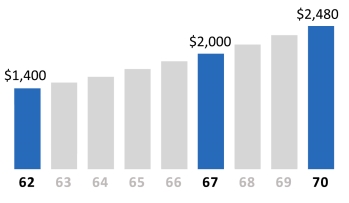
The following chart illustrates how much a monthly benefit of $2,000 taken at a full retirement age of 67 would be worth if taken earlier or later than full retirement age. For example, as this chart shows, this $2,000 benefit would be worth $1,400 if taken at age 62, and $2,480 if taken at age 70.

This hypothetical illustration is based on Social Security Administration rules. Actual results will vary.

Working may affect your retirement benefit

You can work and still receive Social Security retirement benefits, but the income that you earn before you reach full retirement age may temporarily affect your benefit. Here’s how:

  • If you’re under full retirement age for the entire year, $1 of your benefit will be withheld for every $2 you earn over the annual earnings limit ($21,240 in 2023)
  • A higher earnings limit applies in the year you reach full retirement age, and the calculation is different, too — $1 of your benefit will be withheld for every $3 you earn over $56,520 (in 2023)

Once you reach full retirement age, you can work and earn as much income as you want without reducing your Social Security retirement benefit. And keep in mind that if some of your benefits are withheld prior to your full retirement age, you’ll generally receive a higher monthly benefit at full retirement age, because after retirement age the SSA recalculates your benefit every year and gives you credit for those withheld earnings.

Retirement benefits for qualified family members

Even if your spouse has never worked outside your home or in a job covered by Social Security, he or she may be eligible for spousal benefits based on your Social Security earnings record. Other members of your family may also be eligible. Retirement benefits are generally paid to family members who relied on your income for financial support. If you’re receiving retirement benefits, the members of your family who may be eligible for family benefits include:

  • Your spouse age 62 or older, if married at least 1 year
  • Your former spouse age 62 or older, if you were married at least 10 years
  • Your spouse or former spouse at any age, if caring for your child who is under age 16 or disabled
  • Your children under age 18, if unmarried
  • Your children under age 19, if full-time students (through grade 12) or disabled
  • Your children older than 18, if severely disabled

Your eligible family members will receive a monthly benefit that is as much as 50% of your benefit. However, the amount that can be paid monthly to a family is limited. The total benefit that your family can receive based on your earnings record is about 150% to 180% of your full retirement benefit amount. If the total family benefit exceeds this limit, each family member’s benefit will be reduced proportionately. Your benefit won’t be affected.

For more information on retirement benefits or the application process, contact the Social Security Administration at (800) 772-1213 or visit ssa.gov.

Signing up for Social Security

According to the Social Security Administration, you should apply for Social Security benefits approximately three months before your retirement date. To apply for Social Security benefits, you can complete an application online or call or visit your local Social Security office. You can also call the SSA at (800) 772-1213 to discuss your options or to get more information about the application process.

If you are interested in our Social Security planning options, learn more here! We understand that retirement planning can be daunting, and we are here to make it easier for you. Our newsletter is a great way to stay up-to-date with our latest offerings and get helpful retirement planning tips. Signing up is easy; click here. We appreciate your interest in our services and look forward to helping you retire better!

Broadridge Investor Communication Solutions, Inc. prepared this material for use by Social Security Benefit Planners, LLC.

Broadridge Investor Communication Solutions, Inc. does not provide investment, tax, legal, or retirement advice or recommendations. The information presented here is not specific to any individual’s personal circumstances. To the extent that this material concerns tax matters, it is not intended or written to be used, and cannot be used, by a taxpayer for the purpose of avoiding penalties that may be imposed by law. Each taxpayer should seek independent advice from a tax professional based on individual circumstances. Social Security Benefit Planners, LLC  provide these materials for general information and educational purposes based upon publicly available information from sources believed to be reliable — we cannot assure the accuracy or completeness of these materials. The information in these materials may change at any time and without notice.

Social Security Benefit Planners, LLC and its affiliates are in no way associated with or approved, endorsed, or authorized by the Social Security Administration.

Minimizing Taxation of Your Social Security Retirement Benefit

Minimizing Taxation of Your Social Security Retirement Benefit

Your Social Security retirement benefit may be taxableMinimizing Taxation of Your Social Security Retirement Benefit

Did you know that you might have to pay federal income tax on your Social Security retirement benefit? If the only income you had during the year was Social Security income, then your benefit usually isn’t taxable. However, if you earned other income during the year or had substantial investment income, then you might have to pay federal income tax on part of your benefit if your total income exceeds a certain base amount.

If you have earned income or investment income over the base amount, you can use certain strategies to minimize (or even eliminate) the amount of tax you have to pay on your Social Security benefit. These strategies include changing your filing status and reducing your modified adjusted gross income (MAGI). However, before using these strategies, consult your tax advisor for information on your individual situation.

Is your benefit taxable?

Determining whether your Social Security retirement benefit is taxable

Before you consider ways to minimize taxation of your Social Security retirement benefit, you must determine whether your benefit is taxable at all. Your benefit is taxable if one-half of your Social Security benefit plus your MAGI exceeds the base amount for your filing status.

Your MAGI includes taxable pensions, wages, interest, dividends, and other types of taxable income. It also includes tax-exempt interest income plus normally excludable income such as interest from Series EE savings bonds (which may also be called Patriot bonds) and the foreign earned income of U.S. citizens and residents.

Your filing status

When you fill out your federal income tax return, you choose your filing status based on your marital status. You can file in one of five ways: single, married filing jointly, married filing separately, unmarried head of household, or qualifying widow or widower (with a dependent child). For Social Security purposes, your filing status is important because the amount of income you can have before your benefit is taxable depends partly on your filing status.

The base amount for your filing status

How much income you can have before your Social Security benefit becomes taxable is known as the base amount. The base amount is determined by law and is not adjusted annually for inflation. The base amount that you use to determine the taxability of your Social Security benefit depends upon your filing status. Your base amount is:

  • $25,000 if you file as single, head of household, or qualifying widow(er)
  • $25,000 if you file as married filing separately and you lived apart from your spouse for all of the tax year
  • $32,000 if you file as married filing jointly
  • $0 if you file as married filing separately and you lived with your spouse at any time during the tax year

How much Social Security retirement benefit you received

At the end of each tax year, the Social Security Administration (SSA) will send you a form (SSA-1099 or RRB-1099) showing the amount of benefit you received during the year. You can use this to figure out whether any of your benefit will be taxable.

Adding it all up

You can use Worksheet A in IRS Publication 915, Social Security and Equivalent Railroad Retirement Benefits to calculate whether your total income (as defined above) exceeds the base amount for your filing status. This worksheet has the following steps:

  • Enter the amount from box 5 of all your Forms SSA-1099 and RRB-1099. Include the full amount of any lump-sum benefit payments received in the current tax year, for the current tax year and earlier years. (If you received more than one form, combine the amounts from box 5 and enter the total.)
  • Note: If the amount on line A is zero or less, stop here; none of your benefits are taxable this year.
  • Enter one-half of the amount on line A.
  • Enter your taxable pensions, wages, interest, dividends, and other taxable income.
  • Enter any tax-exempt interest income (such as interest on municipal bonds) plus any exclusions from income.
  • Add lines B, C, and D.
  • Note: Compare the amount on line E to your base amount for your filing status. If the amount on line E equals or is less than the base amount for your filing status, none of your benefits are taxable this year. If the amount on line E is more than your base amount, some of your benefits may be taxable. You need to complete Worksheet 1.

How much of your benefit is taxable?

What percentage of your retirement benefit is taxable?

Even if you determine that your Social Security retirement benefit is taxable, you won’t have to pay tax on your whole benefit. Either up to 50 percent or up to 85 percent of your benefit will be taxable, depending on your filing status and whether the total of your MAGI and one-half of your Social Security benefit exceeds a certain limit.

What is your modified adjusted gross income?

On IRS Form 1040, adjusted gross income (AGI) is your gross income minus certain “above-the-line” deductions allowed by law. These include:

  • Certain business expenses of reservists, performing artists, and fee-basis government officials
  • IRA deduction
  • Student loan interest deduction
  • Health savings account deduction
  • Deductible part of self-employment tax
  • Self-employed health insurance deduction
  • Self-employed SEP, SIMPLE, and qualified plans
  • Penalty on early withdrawal of savings
  • Domestic production activities deduction

Your MAGI is your AGI, minus (or not including) the taxable amount of your Social Security benefits, plus income that is normally not included in AGI (such as foreign earned income and income from qualified U.S. savings bonds).

When up to 50 percent of your retirement benefit will be taxable

Up to 50 percent of your retirement benefit will be taxable if the total of one-half of your benefits and your MAGI is more than the following base amount for your filing status:

  • $25,000 if you’re filing as single, head of household, or qualifying widow(er)
  • $25,000 if you’re filing as married filing separately and you lived apart from your spouse for the whole tax year
  • $32,000 if you’re filing as married filing jointly

When up to 85 percent of your benefit will be taxable

Up to 85 percent of your retirement benefit will be taxable if one-half of your Social Security benefit plus your MAGI exceeds the following base amount for your filing status:

  • $34,000 if you’re filing as single, head of household, or qualifying widow(er)
  • $34,000 if you’re filing as married filing separately and you lived apart from your spouse for the whole tax year
  • $44,000 if you’re filing as married filing jointly
  • $0 if you’re filing as married filing separately and you lived with your spouse at any time during the tax year
Calculating your taxable benefits

Because the calculation is complex, you need to use a worksheet to compute your taxable benefit. Several worksheets are available from the IRS. What worksheet you use depends upon your situation. In general, you can use the worksheet available in the instructions for IRS Form 1040 (or 1040A) or Worksheet 1 in Publication 915. However, you must use a worksheet specified by the IRS if any of the following situations apply to you:

  1. You contributed to a traditional individual retirement arrangement (IRA) and your IRA deduction is limited because you or your spouse is covered by a retirement plan at work. In this situation, you must use the special worksheets in Appendix B of Publication 590 to figure both your IRA deduction and your taxable benefits.
  2. Situation (1) doesn’t apply and you take an exclusion for interest from qualified U.S. savings bonds (IRS Form 8815), for adoption benefits (IRS Form 8839), for foreign earned income or housing (IRS Form 2555 or IRS Form 2555-EZ), or for income earned in American Samoa (IRS Form 4563) or Puerto Rico by bona fide residents. In this situation, you must use Worksheet 1 in Publication 915 to figure your taxable benefits.
  3. You received a lump-sum payment for an earlier year. In this situation, also complete Worksheet 2 or 3 and Worksheet 4 in Publication 915.

Tax considerations

You may be able to deduct the amount of Social Security retirement benefit that was taxed from your state income tax return

Check with your tax advisor or state tax official to find out if your state allows this deduction.

Questions & Answers

If your child receives Social Security benefits but the check is made out to you due to his or her age, do you need to include the amount of benefit your child receives in the calculation to determine whether your own Social Security benefit is taxable?

No. Your child’s benefit doesn’t affect whether your benefit is taxable, even if the check is made out in your name.

When will you receive your annual statement from the Social Security Administration showing how much benefit you were paid during the year?

You should receive your annual statement by January 31 of the year following the year of benefit payments.

If you know that you’re going to owe income tax on your Social Security benefit, can you have that tax withheld?

Yes. You can fill out IRS Form W-4V, Voluntary Withholding Request, and choose to withhold a specific percentage of your total benefit payment. If part of your benefit is taxable, you may have to make estimated tax payments or request additional withholding from other income next year.

We love to help you retire better. Check out our many Social Security planning options. Also, we love to keep in touch with our newsletter; click here to sign up.

Broadridge Investor Communication Solutions, Inc. prepared this material for use by Social Security Benefit Planners, LLC.

Broadridge Investor Communication Solutions, Inc. does not provide investment, tax, legal, or retirement advice or recommendations. The information presented here is not specific to any individual’s personal circumstances. To the extent that this material concerns tax matters, it is not intended or written to be used, and cannot be used, by a taxpayer for the purpose of avoiding penalties that may be imposed by law. Each taxpayer should seek independent advice from a tax professional based on individual circumstances. Social Security Benefit Planners, LLC  provide these materials for general information and educational purposes based upon publicly available information from sources believed to be reliable — we cannot assure the accuracy or completeness of these materials. The information in these materials may change at any time and without notice.

Social Security Benefit Planners, LLC and its affiliates are in no way associated with or approved, endorsed, or authorized by the Social Security Administration.

When will I receive my first Social Security check?

This is a common question we get when we do a full Social Security Benefit session. “When will I receive my first check”. It’s important to understand that As of March 1, 2013, the Social Security Administration stopped mailing paper checks. There are two ways you can receive your benefits:

1. Direct deposit of your Social Security checks. This option puts them right into your bank account on the day they are paid.

You don’t have to worry about your check being lost or worry that funds will not get to the bank in time if you are out of town. Sign up or learn more at Frequently Asked Questions About Social Security Direct Deposit.

2. Direct Express® Debit Card – If you do not sign up for direct deposit, your benefits will be paid to you via Direct Express® debit card option. This card will work anywhere that takes Debit Mastercard®. You can also use your Direct Express® debit card to get cash back at the grocery store or to purchase money orders at the post office.

Social Security checks are deposited on the second, third, or fourth Wednesday of each month, depending on your day of birth. The Social Security check schedule works as follows:

If you were born on the:

1st–10th of the month: Expect your Social Security check to be deposited on the 2nd Wednesday of each month.

11th–20th of the month: Expect your Social Security check to be deposited on the 3rd Wednesday of each month.

21st–31st of the month: Expect your Social Security check to be deposited on the 4th Wednesday of each month.

Exceptions to When Social Security Checks Arrive

For every rule, there are always exceptions. If you fall into one of the categories below, your check may arrive on an alternate schedule.

You started receiving benefits before 1997: Your Social Security check is paid on the third day of the month. You can request to change this according to the day of birth schedule above.

You are receiving both Social Security benefits and SSI payments: Expect your Social Security check to be deposited on the third day of the month.

Holiday exceptions: If the day your Social Security check is supposed to be deposited is a holiday, your check will be deposited the previous day.

If you have questions on how to Maximize your Social Security Benefits, contact us today. This is what we do! Helping thousands of people that look for ways to maximize their retirement and live a better life.

Can I count on Social Security when I retire?

When I have the opportunity to meet with people or speaking at a event, probably the most popular question I get is: “Can I count on Social Security to be there when I retire”? Of course the majority of that question comes to me where peoples ages range from 40-55. The young people I talk to assume social security will NOT be there. That’s a shame.

The latest Social Security Trustees Report projects that the Social Security trust fund will run out of money in just 18 years, or 2033. But even if that forecast proves accurate, it doesn’t mean payments will stop. The payroll taxes that Social Security collects from workers and employers will still be able to fund 77% of scheduled benefits.

So the real issue is whether benefits will be cut, not eliminated.
In my opinion, I would be very surprised if people in their mid-50s or older see their benefits scaled back. That said, even if their payments aren’t reduced, they could be trimmed in other ways, such as making more of their Social Security income taxable.

I think for the younger generation, Social Security maybe changed, but never deleted. I say to young people that it’s always better to plan ahead of time so your NOT so dependent on social security for retirement.

When Should I Take My Social Security?

As a Social Security Benefits Planner, we get this question all the time. In fact, it’s probably the most asked question. So it’s important to realize that the decision of when to retire is separate from the decision of when to claim Social Security benefits. For example, depending on circumstances, you might find that it makes sense to retire at a given age, yet hold off on claiming Social Security until a later date — maybe even several years later.

By waiting until age 70 rather than claiming as early as possible at age 62, you can increase your monthly benefit amount by roughly three-quarters. Of course, by waiting, you decrease the number of months in which you’ll be receiving a Social Security check.

So how can you tell if the trade-off is worth it? One way to compare two possible ages for claiming benefits is to compute the age to which you would have to live for one strategy to become superior to the other strategy. Another way to analyze the decision is to compare the payout you get from delaying Social Security to the level of income you can safely get from other retirement income sources.

According to the Social Security Administration, the average total life expectancy for a 62-year-old female is 84.8. For a male, it’s 82. In other words, from a breakeven perspective, most unmarried retirees will be best served by waiting to take their retirement benefit.

This is why it’s always a good idea to have other sources of retirement income. In other words, for each dollar of Social Security you give up now (by delaying benefits), you can expect to receive a greater level of income in the future than you could safely take from a dollar invested in a typical stock/bond portfolio.

A similar analysis can be performed for each year up to age 70, and the conclusion is the same: Delaying Social Security benefits can be an excellent way to increase the amount of income you can safely take from your portfolio.

Of course, there are circumstances in which it would not make sense for an unmarried person to delay taking Social Security.

First and most obviously, if your finances are such that you absolutely need the income right now, then you have little choice in the matter.

Second, if you have reason to think that your life expectancy is well below average, it may be advantageous to claim benefits early. For example, if you have a medical condition such that you don’t expect to make it past age 64, it would obviously not make a great deal of sense to choose to wait until age 70 to claim benefits.

In Summary:

For unmarried retirees, from a breakeven perspective, you’ll be best served by waiting until age 70 to claim benefits if you expect to live past age 80.5. (And, for reference, the average total life expectancy for a 62-year-old female is 84.8. For a male, it’s 82.)

For unmarried retirees, on a dollar-for-dollar basis, the lifetime income you gain from delaying Social Security is generally greater than the level of income you can safely get from other sources. As a result, delaying Social Security can be a great way to increase the amount you can safely spend per year. (Or, said differently, it can be a great way to reduce the likelihood that you will outlive your money.)

The shorter your life expectancy and the greater the available yield on inflation-protected bonds, the less desirable it is to delay claiming Social Security benefits.

Still confused about what is right for you? Get our FREE E-Book on Social Security Basics and start getting your questions answered. Faye Sykes is a National Speaker on Social Security and understands how to maximize your Benefits.


Social Security Benefits Frequently Asked Questions

According to the United States Government, over 59 million individuals will receive approximately $863 billion in Social Security benefits this year. With numbers like that, chances are good that you or someone you know may be eligible for benefits soon.  Social Security Benefit Planners answer some of the more common questions people ask about Social Security.

Do I qualify for Social Security retirement benefits?

Depending on your date of birth, the normal age of retirement (a government term related to the age in which benefits can kick in) is 65-67.  Take our quiz and find out exactly how much you understand about your own Social Security Benefits. You can apply for benefits if you are at least 61 years and 9 months old, or as late as age 70.

How do I apply for Social Security benefits?

You can apply for Social Security benefits either online, or in person at the Social Security office if there is one in your city. Click on our Interactive Map and find out how we can help in YOUR State

The Social Security Administration recommends starting the application process at least four months in advance of your planned retirement, and you will need information such as your birth certificate, Social Security card, and other government-issued documents. This list published by the Social Security Administration gives the full list of documents that may be needed for your application.

When is the best time to apply?

Every individual’s needs are different, but factors that may impact your decision to collect retirement can include your health, your financial needs, your other sources of income, and your plans to work after you start collecting your benefits. This is because the total dollar amount of your benefits will vary based on how old you are when you claim the benefit and whether or not you are still working.

If you are getting a divorce, you should also be thinking about Social Security. If you were married at least 10 years and do not ever re-marry, you may qualify for benefits based on your former spouse’s earnings when you both reach age 62. The result is that you could receive the higher of benefits based on your own work history or half of your former spouse’s benefit, even if he or she has remarried.

How much Social Security am I entitled to?

As of 2014, the maximum benefit per month for a person who earned the maximum taxable earnings for 35 years or more is $2,663 per month. However, the average monthly retirement benefit is $1,328.  Learn about the FACTS of Social Security

Have more questions about how to Maximize YOUR Social Security? Ask Faye Sykes, National Speaker for Social Security Benefit Planners and learn how planing now will save you time and money later.

Lost my Social Security Card

You’ve lost your Social Security Card, what do I do? First of all, don’t panic. They’re lot’s of protections now that will alert you if your number is being used. But the most important thing to do is REPORT IT! Any time you lose sensitive personal information such as your Social Security card, it is a good idea to request an initial security alert be added to your credit report. An initial security alert is free and remains on your report for 90 days. It lets creditors know that you may be a victim of identity theft so someone could be trying to apply fraudulently for credit in your name.

The easiest way to request a security alert is by going online, although you can also request the alert by phone or by mail. To add an alert via the Internet, visit Experian’s online Fraud Center and select “Add an initial security alert.” Simply complete the form and submit it through the secure Web link. To add an alert by phone call 1 888 EXPERIAN (1 888 397 3742) and select the fraud option. Follow the voice instructions to add an alert and request a report.  After you have reported it for credit reasons, now report it to the Social Security Administration

Contact the Social Security Administration

Contact the Social Security Administration to let them know the card was lost and to request a new one. For more information, please visit the Social Security Administration’s site.

How do I replace it?

It is free to replace your social security card if it has been lost or stolen. You are limited to 3 replacement cards in a year and 10 during your lifetime. Legal name changes and other exceptions do not count toward these limits. For example, changes in immigration status that require card updates may not count toward these limits. Also, you may not be affected by these limits if you can prove you need the card to prevent a significant hardship.

In order to get a replacement social security card you will need to provide documentation that proves you are a US citizen and your identity. All documents must be either originals or copies certified by the issuing agency. The social security office will not accept photocopies, notarized copies of documents or receipts showing you applied for the document. Social Security may use one document for two purposes, such as using your US passport as proof of both citizenship and identity.

COMPLETE AND PRINT SOCIAL SECURITY CARD APPLICATION FORM

Once you have the necessary documents the next step would be to print out the social security card application and fill it out. Once you fill it out and print it you need to then either take it to your local social security office or mail it to the office. Click here for the application form. If you have questions or issues about replacing your Social Security card then you need to contact your local administration office.

For more questions regarding your Social Security Benefits, or want to learn Social Security Basics? Contact Faye Sykes and learn how you can maximize your benefits.

Top Tips for Business Owners to Maximize Retirement Income

Are you a business owner with an at-home spouse who helps out with bookkeeping or a variety of other tasks that need to be done? Once you get to retirement age it’s too late, but for those of you that are in your 20’s, 30’s, 40’s or even 50’s there’s still time to let these efforts build future benefits. Paying your spouse at least $4,880 a year will ensure that they continue to vest into the Social security system, which will help you at retirement time.

To fully vest you need to earn 40 credit hours, with a maximum of 4 credits per year at $1220 per credit.  Spouses who are not vested can still pull a half benefit off of their working spouse’s retirement benefit (or ex-spouse’s, if married over 10 years). If widowed after being married 9 months or more, you can draw benefits up to your deceased spouse’s full amount, depending on what age decide to file.

If both spouses have work history the social security retirement benefits picture can drastically change for the better. With two vested partners you’ll also have more options, such as the potential for the lower earning spouse to pull earlier while delaying the higher earning spouse’s filing until age 70 to get the highest benefit. And don’t forget that social security disability benefits are hinged on a person working at least 5 out of the last 10 years, which can help when the worst happens.

As you can see, it’s in your best interest to ensure that the work both partners contribute to your business is recognized as paid employment by the Social Security Administration. We offer a pre-check social security flat fee planning option that will help you review where you are today and give you insight about the impact on future income you can make by ensuring that both spouses are being paid for the work that they do.

Please “Select a Plan” so we can get started on maximizing your social security benefits or take our quiz to find out how much you know about your social security.

Social Security for Dependent Parents

Parents take care of us for so many years, and in some cases we are able to help our own parents in their retirement.  But what will happen if your dependent parent doesn’t outlive you?

Very few people know about an important social security benefit that can help your financially dependent parent should you die. If your parent relies on you for more than half of their living expenses, they may be able to receive benefits after your death. In order to take advantage of this benefit you must have earned enough credits to qualify for social security – that’s 40 credit hours – and your parent must:

Receive at least half of his or her support from you

  • Be at least 62 years old
  • Not have remarried since the adult child’s death
  • Not have an individual social security benefit that’s more than the potential benefit based on your earnings

How This Affects Social Security Benefit Planning

First, the age at which you claim your own retirement benefit doesn’t affect the time at which your parent can start receiving a parent’s benefit. (It is your date of death that determines that.)

Second, the age at which you claim your retirement benefit doesn’t affect the amount of your parent’s benefit based on your work record. The amount of a parent’s benefit is 82.5% of the deceased person’s primary insurance amount if there is one eligible parent. If there are two eligible parents, each parent’s benefit as a parent is 75% of the deceased person’s primary insurance amount. (If the parent is already receiving a different Social Security benefit — such as their own retirement benefit — then the total amount they will receive is the greater of the two benefits.)

We offer a FREE Quiz that you can take to test your knowledge on YOUR social security. Most often people wait until they need it the most.  Don’t be that person. Contact us today! Or Call: 877-270-SSBP (7727)

What Every Expat Needs to Know About Social Security

So you have decided to work or retire out of the United States. How does this affect your Social Security and Medicare benefits? The answer varies by country, and it will work out better for you in certain countries than in others. It’s important to understand what is at stake.  We broke down what Expats or (Expatriate) needs to know

  • About 20 countries have agreements to prevent double taxation. In the rest, you will pay taxes to your host country as well as Uncle Sam.
  • About 25 countries maintain bilateral agreements that allow you to transfer social security credits to and from the US. For example, if you work in the US for 20 years and then move to Canada and work there for another 10 years, when you retire you can transfer your US credits to Canada to vest into their system (or vice versa).
  • There are a few countries, such as North Korea and Cuba, where you will not be allowed to receive social security benefits while living there.
  • Your non-US spouse may or may not be entitled to your benefits if you were to pass. The laws vary by country and are quite complex.
  • If you think you will ever move back to the US then it is very important to sign up for Medicare part A, which is free, at age 65. There are ways to opt out of part B if you qualify, but if you do not sign up for part A there are permanent penalties that will persist throughout your retirement.
  • If you worked overseas and did not pay into social security for certain years, your pension from that country will most likely trigger a Windfall Earnings Provision (WEP) that partially offsets your social security benefit.

Determining retirement benefits for expats can be a confusing and complex situation, with many country-specific rules that change over the years. If you need help navigating social security options for expats and their families, please visit our website at www.socialsecuritybp.com to learn more.

How does Divorce and Social Security Work?

How does Divorce change my Social Security

We get a lot of questions regarding Divorce and Social Security. How it works, and who qualifies for what? Filing for Social Security involves a dizzying array of choices and decisions. When should you claim benefits? What’s the best way to maximize your income? Selecting the right options isn’t easy for anyone, and for those who are divorced it can be even harder. If you’re confused by the myriad of rules and regulations around filing for Social Security as a divorced individual, keep these guidelines in mind:

If you were married over 10 years, you can claim spousal benefits. This is true as long as you meet the following conditions:

  • You’ve been divorced for at least two years at the time you file.
  • You have not remarried.
  • You have reached the age of 62 (or older).
  • Your spouse is qualified by work history and citizenship to claim Social Security retirement/disability benefits.

Your spousal benefit will be equal to one half of the full retirement amount your ex-spouse is qualified to receive, assuming you file at your full retirement age. In many cases, this could be more than the amount you would receive based on your own work history – if you were out of the work force caring for children, for example. If your own work record is higher than you will receive your own benefit. In either case if you file at age 62 this could reduce your benefit as much as 30% for the rest of your retirement which can cost you thousands of retirement dollars.

You can receive the full amount of your ex-spouse’s Social Security benefit if he or she passes away. If your ex-spouse is deceased you can receive benefits as a widow or widower instead of spousal benefits. You qualify for the full amount of your ex-spouse’s retirement benefit, just as you would if you had still been married at the time of death. The rules are similar to those for spousal benefits:

  1. The marriage must have lasted at least 10 years.
  2. You must have attained your full retirement age (your benefit will be less if you file early).
  3. You must not have remarried before age 60. A marriage at or after the age of 60 will not affect your ability to qualify for this type of benefit.

In both types of Social Security benefits, it makes no difference whether your spouse has remarried one or more times. These benefits are yours if you qualify based on your age and marital status, even if there is a current spouse or widow who also collects benefits.

Still confused? Please contact our office for a consultation. We’ll help you clarify your options and find your best path forward. Social Security Benefit Planners 877-270-SSBP (7727) [email protected]

Stop Screwing Yourself, Business Owners!

Business owners typically prioritize the success of their company over other financial goals. That’s a good thing in general, but it’s important to keep a balance or you could be creating a host of long-term financial problems for yourself while you’re trying to do the right thing.

A common pattern I see with my clients is that they pay themselves as little as possible and put the vast majority of the available money back into the business. That may be good for the business but it’s not necessarily a smart move for your overall financial picture. When it’s time for retirement, problems arise:

  • Little Social Security income. By keeping the amount you pay yourself low over the years, you deprive yourself of Social Security benefits you might have been able to collect later. The amount of monthly benefit you receive is calculated based on your average earnings over a 35-year period. If you didn’t pay yourself much, the government won’t either.
  • Minimal retirement savings. When you plough all the profits back into the company you reduce the amount available to fund your personal retirement account. That means you don’t have a substantial nest egg that’s growing to take care of you once you’re ready to hand the business over to new owners.
  • Expecting too much. Selling your business when retirement beckons may deliver a nice bundle to provide for your financial needs in the coming years. Then again, it might not. Economic conditions shift, and the type of business you own can make a huge difference in the amount you can actually sell it for.

Take care of your business, but be sure to look out for your own best interests as well. Paying yourself a fair wage and investing in assets like equities and real estate are just as important as that new equipment or extra staff member your company could use. The money you pay into Social Security and invest privately will work together to give you a higher income in retirement than you’d have otherwise.

If you’re not sure how much you should be paying yourself or investing, please contact us today and we’ll help you find the right balance. You deserve a comfortable retirement!

Social Security Benefit Planners
800.270.SSBP (7727) [email protected]

Military Service and Social Security – How it works

Worried about how your military service affects your Social Security? You don’t have to, because the retirement income you’ve earned through military service won’t reduce your Social Security benefits. In fact, if you served on active duty between 1957 and 2001, you may even be credited for extra earnings on your Social Security record.

For Social Security purposes, active duty includes active duty, reserve duty and active duty for training (ACDUTRA), and includes your service in the:

  •         Army
  •         Navy
  •         Air Force
  •         Marines
  •         Coast Guard
  •         National Guard
  •         Public Health Service (service as a commissioned officer)

Although your benefits are not impacted by retirement income from the military, Social Security benefits for survivors may reduce the income beneficiaries receive through the Department of Defense Survivors Benefit Plan. Your military retirement advisor or the Department of Defense will be able to offer information specific to your situation.

Whenever you served, the American people thank you and wish you a happy retirement, complete with all the Social Security benefits to which you are entitled. Want assistance in understanding optimal options for maximizing your Social Security? Choose one of our plans and please use USA2017 to save $50 off any plan.

Social Security and Railroad Earnings

Working for a railroad means your Social Security benefits may be calculated differently than for other industries. To qualify for a pension from the Railroad Retirement Board, which maintains your record of earnings, you’ll need to have worked for the railroad at least 120 months or 60 months of railroad work that took place after 1995.

  • For railroad workers whose work history includes less than five years of service since 1995 and less than ten total years of railroad work, your railroad earnings will be added to your other work history to calculate your Social Security credits and your benefits from Social Security. To see your earnings history, you can view your Social Security Statement online. Note that railroad earnings prior to 1973 do not show on your statement but are included in calculating the credits shown and your estimated benefits.
  • Workers who have at least ten years of railroad work or five or more years of railroad work since 1995 usually qualify for a pension from the Railroad Retirement Board. The earnings from this railroad will not be used to calculate Social Security credits or benefits.
  • If you’re entitled to a pension from the Railroad Retirement Board, you can still receive Social Security benefits as long as your work history includes enough credits to qualify for Social Security based on your non-railroad employment history. However, your Tier 1 Railroad Retirement Annuity will be reduced if you also receive Social Security.

We are here to help if you would like to project what your retirement income options will look like.  Please go to our “Select a Plan” to learn more and sign up and use RAILROAD2017 to save $50 off any plan.

Are Employees of Foreign Governments Covered by Social Security?

Working inside the U.S. as an employee of a foreign government or an instrumentality of one can mean you’re not covered by Social Security. These workers include diplomats, embassy employees, non-diplomatic representatives, consular officers and employees of foreign government instrumentalities (non-commercial organizations that function on behalf of a foreign government).

Whether or not your work will be counted toward Social Security benefits is controlled by your citizenship status.

U.S. Citizens who work for a foreign government are treated as self-employed citizens are for Social Security. Your employer will not withhold Social Security taxes but your earnings can still count toward your coverage under the program. You are responsible for paying self-employment taxes on the income. Citizens who work for an instrumentality are covered by Social Security, but their earnings may be treated as employment or self-employment based on three conditions. The U.S. Department of State and the IRS will determine which category your work falls into.

Non-citizens are not covered by Social Security for work they perform for a foreign government. Their employment for an instrumentality of a foreign government may or may not be covered by Social Security, depending on same three conditions mentioned above.

Dual citizens who hold citizenship in the U.S. and another country are covered by Social Security in most cases, but depending on the country for which they are working, they may need to pay self-employment taxes or not. Dual citizens who work for an instrumentality of a foreign government may or may not be exempt from paying Social Security taxes on their earnings. Reciprocal social security agreements between the U.S. and foreign governments vary by country, so it is important that dual citizens speak with a qualified professional or governmental administrator to determine program eligibility and tax responsibilities.

If you want to understand options that pertain to your situation please go to our “Select a Plan” and sign up for one of our planning options. Use FOREIGN2017 to receive $50 off any plan.


Social Security for Federal Government Employees

Long-time employees of the Federal government may be confused about their Social Security benefits, and it’s easy to understand why. The U.S. government changed the retirement system for their employees in 1984, and only one of those systems include earnings for Social Security.

Prior to 1984, all employees were covered under the Civil Service Retirement System (CSRS), which did not withhold Social Security taxes from workers’ earnings. As a result, these earnings do not qualify government workers for Social Security credits or benefits.

The retirement system that replaced the CSRS is the Federal Employees Retirement System (FERS), and under this system Social Security taxes are withheld from workers’ earnings. These earnings are included in calculating Social Security credits and benefits.

Everyone who began working for the Federal government during or after 1984 is covered under Social Security, assuming a sufficient work history to earn the required 40 credits.

Federal employees who switched to the FERS program are also covered under Social Security; all the work they performed after switching to FERS is counted toward their Social Security credits and these earnings are used to calculate benefits.

Some workers who were already covered under CSRS chose to remain under that program after FERS was available. These employees have not contributed into Social Security and are not eligible to receive benefits under the program. However, they are eligible to receiver Medicare Part A coverage after they earn the 40 quarterly credits required of all participants.

We want to help you customize retirement income options socialsecuritybp.com and use FEDERAL2017 for $50 off any plan option.

Social Security Experts

Social Security Benefit Planners (SSBP) can help you answer that question. With over 2,700 regulations governing Social Security, it’s not surprising that few people know they qualify for so much more. Our team of financial experts and researchers look at your individual life circumstances to create a report detailing your options, and help you create a strategic plan to make the most of those options. Ready to discover what you actually qualify for?

Who Needs Social Security Planning?

Anyone who qualifies to receive Social Security benefits and either hasn’t yet elected to receive their benefits or is within the first 11 months of receiving them can benefit from a detailed analysis and plan, including:

  • Married couples who want to understand which options will benefit them the most
  • Business owners who pay themselves little and put all or most of their money back into their business
  • Immigrants who want to learn what they need to do in order to qualify for benefits
  • Retirees who provide full time care for their minor children or grandchildren
  • Widows and widowers with minor children
  • Widows and widowers age 60 or older (age 50 or older if disabled)
  • Recently married same-sex couples who want to know more about their newly qualified benefits
  • Divorcees close to retirement
  • Disabled persons who are unable to work
  • People with unique situations who want to learn the best strategy for maximizing their benefits

We Help More Than Just Retirees

Many different circumstances could qualify you and your family for Social Security benefits. Here are just a few examples of those we’ve assisted:

  • A woman whose older ex-husband had been collecting Social Security was able to file for benefits for their mutual biological minor child – delivering almost $150k of support over the next nine years.
  • A recently married couple in their 60s was able to draw spousal benefits that increased their current income by nearly $13k per year, while still delaying filing for the wife’s benefits until age 70, when they will be at their highest level.
  • A woman who was able to pull an extra $300 per month in benefits based on her deceased ex-spouse’s Social Security record, which she did not know she was entitled to draw on.
  • A grandfather who is the full-time caregiver for his 3 minor grandchildren was able to get almost $44K per year in family benefits, which helped keep the family intact.

Read our Client Stories and see how we have helped people maximize their Social Security.  Let’s see if we can help you also.